
Vancouver, British Columbia, February 19th, 2026: Xcite Resources Inc. (CSE:XRI) (“XRI”, “Xcite”or the “Company”), is please to announce, the inclusion of seven dispositions recently acquired by staking in the Uranium City area, northern Saskatchewan by Eagle Plain. The dispositions fall within an Area of Mutual Interest (“AMI”) and as such, will become included in the Don Lake, Smitty and Beaver River projects respectively. The Don Lake – Smitty projects are now contiguous with an additional 2649ha of claims bringing the total area to 4055ha. The Beaver River project has added 1578ha, for a total of 3033ha.
The Uranium City projects are included in a formal Exploration Agreement between Eagle Plains and the Ya’thi Néné Lands and Resource Office (“YNLR”), representing the Athabasca Denesułiné First Nations of Hatchet Lake, Black Lake, and Fond du Lac, the Northern Hamlet of Stony Rapids, and the Northern Settlements of Uranium City, Wollaston Lake and Camsell Portage.
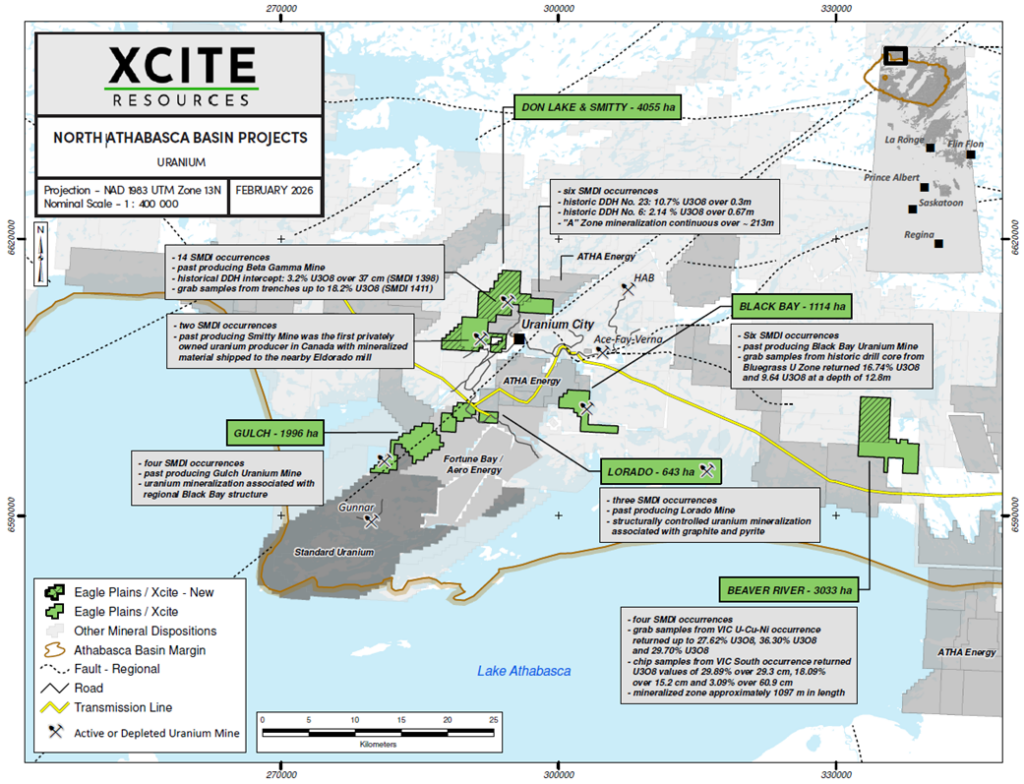
Figure 1- Uranium City project map
Don Lake – Smitty
The new tenures at the Don Lake – Smitty area cover 14 SMDI uranium occurrences, including the past producing Beta Gamma mine and two mineralized zones that have been bulk sampled. The more significant occurrences are described below.
Mineralization at Don Lake – Smitty is described as Beaverlodge type, with structurally controlled, high grade mineralization in veins and breccia-fills within basement rocks. Mineralization often occurs at geological contacts and consists of structures filled with hematite, chlorite and graphite associated with pitchblende (an ore mineral of uranium).
The Beta Gamma Mine (SMDI 1394) was first staked in 1948, to cover the prospective Heron Shear Zone. Trenching and shallow diamond drilling located two mineralized zones approximately 75 meters apart. The No.1 Zone was defined over a distance of approximately 244m with a width averaging 1m, with the No.2 Zone averaging about 1m in width over a distance of 335m. (AF 74N10-081). Between 1953 – 1955, underground development, including a three compartment shaft between the No.1 and No.2 Zones, was completed. The mine was subsequently closed in July 1955, but was reopened in 1958 – 1959, with approximately 150 tons of mineralized material at a reported grade of 0.22% – 0.77% U3O8 shipped to the Lorado mill. (AF 74N10-0161). Resampling of historical trenches by Pelican Minerals Inc. in 2013 returned grab samples from trace amounts up to 0.77% U3O8 (Sample 085126) (MAW00451).
In 1968, SMDI 1476 Tobe Mines Uranium Occurrence 26-1 was discovered and tested by eleven short diamond drill holes totalling 178m, with the best intercept 0.07% U3O8 over 0.9 m from 5.8 – 6.7m in DDH 26-107. (AF 74N10-0161). Later in 1968, a 54 kg bulk sample of surface vein material was shipped to the Eldorado Nuclear Mill with an estimated grade of 60% U3O8. (SMDI 1476).
SMDI 1399 Consolidated Beta Gamma Mines Uranium Occurrences 6E and 6W; and Uranium Zone No. 5, discovered in the early 1950’s, are occurrences of pitchblende in vertical, narrow breccia zones. In 1959, a 10 ton bulk sample of selected mineralized material from the Occurrence 6E was shipped to the Lorado mill. (SMDI 1399).
The West Uranium Showing SMDI 1398, was discovered byBasalt Uranium and Exploration in 1953. The fracture hosted pitchblende mineralization is exposed on surface for approximately 61m. Between 1953-54,5 diamond drillholes were completed on the zone, with the best intercept 3.2% U3O8 over 37cm.
(AF 74N10-0054). In 1970, Saco Mining located and trenched a second showing in the area. Chip samples from the East Zone trenches included 4.3% U3O8 over 25.4cm and 1.3% U3O8 40.7cm. (AF 74N10-0410).
The SMDI 2113 Radiometric Anomaly No. 86 area was first explored in 1969 but mineralization was not discovered until 1975 by Fosago Exploration, who undertook scintillometer prospecting, geological mapping, radiometric surveying, trenching, sampling, rotary drilling and percussion drilling (AF 74N10-0472). Diamond drilling results were inconclusive, but a 50m length, 1.5m width, 3m depth trench exposed pitchblende mineralization in shears and breccia zones. Resampling of the trenches by Pelican Minerals Inc. in 2013 returned grab samples from trace amounts up to 1.89% U3O8 (Sample 085254) and 1.46% U3O8 (Sample 85255) (MAW00451).
SMDI 1411 Aurora Yellowknife Uranium Showing 50-CC2-146
The showing was located in 1950 during a geological investigation. Ten grab samples taken at equal intervals along a 17m length fracture containing erratically disseminated pitchblende returned from 0.01% to 18.20% U3O8 (AF 74N10-0056).
Permitting update
Eagle Plains has made applications with the Saskatchewan Ministry of Environment for Class 2 Exploration Permits for each of the Uranium City projects. The permits include provisions for ground-based geophysics, temporary work camps and diamond drilling.
Geophysics Update
The final deliverables from the 2025 Geotech Airborne Geophysical Surveys VTEM Plus survey have been received. A total of 697line km of survey was completed. The data has been sent to Condor Consulting Inc. for modelling and interpretation, and the results will be used to refine drill targets and to identify areas for ground truthing.
Athabasca Basin History and Mineralization
The Beaver River, Black Bay, Don Lake, Gulch, Lorado, and Smitty projects are located in the Beaverlodge District near Uranium City in the Lake Athabasca region of Saskatchewan. Occurrences of uranium mineralization are abundant in the Uranium City area and have been explored and documented since the 1940s. The Beaverlodge camp was the first uranium producer in Canada, with historic production of approximately 70.25 million pounds of U3O8 between 1950-1982, from ore grades averaging 0.23% U3O8. The two largest producers were the Eldorado Beaverlodge (Ace-Fay-Verna) mine and the Gunnar uranium mine. The Beaverlodge area has seen limited uranium focused exploration since the early 1990’s.
Qualified Person
Technical information in this News Release has been reviewed and approved by C.C. Downie, P.Geo., a director and officer of Eagle Plains, hereby identified as the “Qualified Person” under N.I. 43-101.
About Xcite Resources Inc.
Xcite Resources is an early-stage exploration company working to become a leader in the discovery and development of energy transition metals. The uranium project portfolio in the Athabasca basin will propel the Company’s efforts to achieve a high-grade discovery based on new geological modelling and exploration thesis in a past-producing uranium camp dormant for 40 years. The Uranium City project portfolio constitutes the Don Lake, Beaver River, Smitty, Lorado, Gulch and Black Bay properties.
On behalf of the Board of Directors of Xcite Resources Inc.
Jean-Francois Meilleur, CEO
Contact:
Jean-Francois Meilleur
CEO, Director and Shareholder
Xcite Resources Inc. (CSE:XRI)
jfmeilleur@paradox-pr.ca
+1 514 951 2730
Neither the CSE nor its Regulation Services Provider (as that term is defined in the policies of the CSE) accepts responsibility for the adequacy or accuracy of this news release.
Cautionary Note Regarding Forward-Looking Statements: Certain statements contained in this news release constitute “forward-looking information” as such term is defined in applicable Canadian securities legislation. The words “may”, “would”, “could”, “should”, “potential”, “will”, “seek”, “intend”, “plan”, “anticipate”, “believe”, “estimate”, “expect” and similar expressions as they relate to the Company, are intended to identify forward-looking information. All
statements other than statements of historical fact may be forward-looking information.
Such statements reflect the Company’s current views and intentions with respect to future
events, and current information available to them, and are subject to certain risks,
uncertainties and assumptions, including, without limitation: the potential of the
Company’s mineral properties; the estimation of capital requirements; the estimation of
operating costs; the timing and amount of future business expenditures; and the
availability of necessary financing. Many factors could cause the actual results,
performance or achievements that may be expressed or implied by such forward-looking
information to vary from those described herein should one or more of these risks or
uncertainties materialize. Such factors include but are not limited to: changes in
economic conditions or financial markets; increases in costs; litigation; legislative,
environmental and other judicial, regulatory, political and competitive developments;
and exploration or operational difficulties. This list is not exhaustive of the factors that
may affect forward-looking information. These and other factors should be considered
carefully, and readers should not place undue reliance on such forward-looking
information. Should any factor affect the Company in an unexpected manner, or should
assumptions underlying the forward-looking information prove incorrect, the actual
results or events may differ materially from the results or events predicted. Any such
forward- looking information is expressly qualified in its entirety by this cautionary
statement. Moreover, the Company does not assume responsibility for the accuracy or
completeness of such forward-looking information. The forward-looking information
included in this press release is made as of the date of this press release and the
Company undertakes no obligation to publicly update or revise any forward-looking
information, other than as required by applicable law.